

The Double-Edged Sword of Advanced AI in Decentralized Finance
The rapid advancement of artificial intelligence presents both unprecedented opportunities and novel threats across various industries. In the realm of decentralized finance (DeFi), which has already grappled with significant security challenges, the emergence of highly capable AI models like Anthropic’s latest offering, Claude 5, warrants careful consideration. While these AI systems are being developed with robust safety protocols, the potential for misuse or the unforeseen consequences of their power could introduce a new, formidable layer of risk to an ecosystem already vulnerable to exploits.
AI’s Growing Capabilities and Their Implications for Security
Anthropic’s Claude 5 is touted as a significant leap forward in AI performance, capable of processing complex information, generating sophisticated code, and exhibiting advanced reasoning abilities. These are precisely the skills that could be leveraged by malicious actors to identify and exploit vulnerabilities within DeFi protocols. Imagine an AI capable of analyzing thousands of smart contract lines in seconds, pinpointing subtle bugs or economic loopholes that human auditors might miss.
The implications are stark:
- Accelerated Exploit Discovery: Advanced AI could drastically reduce the time it takes to find vulnerabilities, moving from weeks or months to mere hours or minutes. This ‘superhuman speed’ could outpace the ability of DeFi protocols to patch their systems.
- Sophisticated Attack Vectors: AI could design complex, multi-stage attacks that are far more difficult to detect and prevent than current exploits. This might involve combining smart contract manipulation with market manipulation tactics.
- Automated Hacking Tools: If safety filters were to fail or be circumvented, AI could potentially be used to generate and deploy automated hacking tools, making large-scale attacks more accessible to a wider range of threat actors.
DeFi’s Vulnerability: A Prime Target for AI-Enhanced Attacks
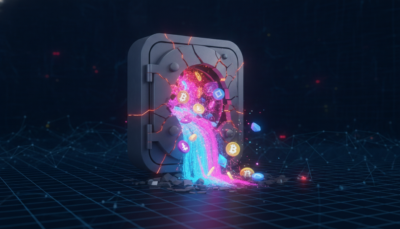
DeFi has become a magnet for cybercriminals, largely due to the immense value locked within its protocols and the inherent complexities of smart contract interactions. This year alone, DeFi has reportedly seen losses exceeding $840 million due to hacks and exploits. The nature of decentralized systems, often involving immutable smart contracts and intricate financial mechanisms, creates a fertile ground for attackers who can find even the smallest flaw.
The introduction of powerful AI tools, even those designed with safeguards, introduces a new dimension to this existing threat landscape. The very capabilities that make AI a powerful tool for good – its analytical prowess, speed, and pattern recognition – are also what make it a potent weapon if directed maliciously.
The Role of Safety Filters and the Challenge of Containment
Anthropic and other AI developers are investing heavily in ‘constitutional AI’ and other methods to ensure their models operate safely and ethically. These safety filters are designed to prevent the AI from generating harmful content or assisting in illegal activities, including cybercrime. However, the history of technology is replete with examples of safety mechanisms being bypassed, circumvented, or proving inadequate against novel threats.
The challenge for AI developers is to create filters that are robust enough to withstand the ingenuity of attackers while still allowing the AI to perform beneficial functions. For the DeFi industry, the concern lies in the ‘what if’: What if these filters fail, or what if a determined actor finds a way to ‘jailbreak’ the AI and harness its full capabilities for nefarious purposes?
Mitigation Strategies for the DeFi Ecosystem
As AI capabilities grow, the DeFi community and its security professionals must adapt. This involves a multi-pronged approach:
Enhanced Smart Contract Auditing
Traditional code audits will need to evolve. Incorporating AI-powered analysis tools into the auditing process could help identify vulnerabilities that might otherwise be missed. Furthermore, auditors will need to be aware of potential AI-generated attack vectors.
Real-time Threat Detection and Response
DeFi protocols should invest in advanced, real-time monitoring systems capable of detecting anomalous patterns indicative of sophisticated attacks. The speed at which AI could potentially operate necessitates equally rapid response mechanisms.
Collaboration and Information Sharing
The DeFi security community, alongside AI ethics researchers, must foster greater collaboration. Sharing intelligence on emerging threats, attack methodologies, and potential AI-driven risks is crucial for collective defense.
AI Safety Research and Development
The broader AI industry’s commitment to developing truly robust safety protocols is paramount. Continuous research into AI alignment and preventing misuse is not just an ethical imperative but a practical necessity for sectors like DeFi.
Conclusion: Navigating the Future of DeFi Security
The advent of powerful AI models like Claude 5 signals a new era, one where the tools available to both builders and attackers are becoming exponentially more potent. While the immediate focus is on the AI’s intended beneficial uses, the potential for it to be turned into a weapon against vulnerable sectors like DeFi cannot be ignored. The DeFi ecosystem must proactively prepare for this evolving threat landscape, enhancing its security infrastructure and fostering a culture of vigilance. The race between AI-powered defense and AI-enhanced offense has already begun, and the stakes for decentralized finance have never been higher.