

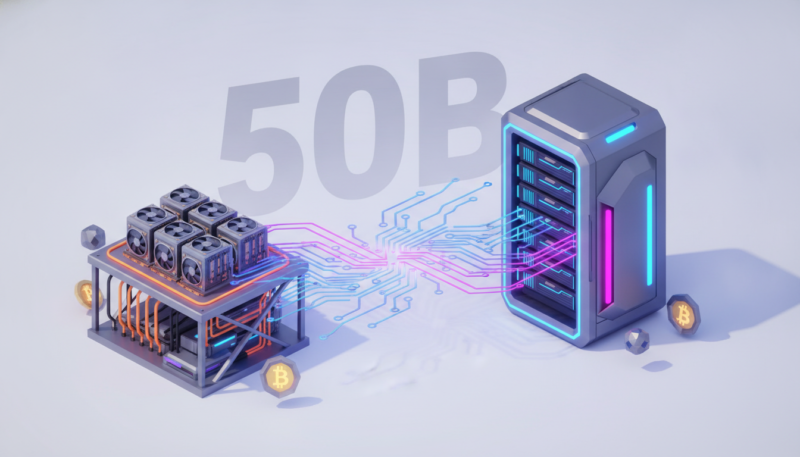
Bitcoin Miners’ AI Pivot Faces a $50 Billion Reality Check, VanEck Warns
The burgeoning narrative surrounding Bitcoin miners transitioning into Artificial Intelligence (AI) infrastructure providers is facing increasing scrutiny from investors, according to a recent analysis by investment management firm VanEck. What was once a promising avenue for diversification and new revenue streams is now being weighed against significant execution risks, potentially impacting a market valued in the tens of billions of dollars.
From Contract Announcements to Execution Risk
VanEck’s report suggests a notable shift in investor sentiment. Previously, announcements of partnerships and plans for AI ventures by Bitcoin mining companies were met with enthusiasm, driving up stock prices and market capitalization. However, the focus is rapidly moving from the promise of future AI revenue to the tangible challenges of actually delivering on these ambitious plans. Investors are now demanding concrete evidence of progress and profitability, rather than relying on speculative contract wins.
This pivot in focus is critical because the AI infrastructure market, particularly for high-performance computing, requires substantial capital investment, specialized hardware, and sophisticated operational capabilities. Bitcoin miners, while possessing significant energy infrastructure and computing power, may not inherently possess all the necessary expertise or hardware to compete effectively in the demanding AI sector.
The $50 Billion Valuation Question
The potential market for AI computing services is vast, and many Bitcoin mining companies have signaled their intent to capture a slice of this market. VanEck’s warning of a potential $50 billion reality check implies that the market valuations assigned to these miners’ AI aspirations might be significantly inflated. If these companies fail to demonstrate successful AI operations and revenue generation, their current market value, which partly reflects these future prospects, could face a sharp correction.
The core of the issue lies in the difference between offering electricity and providing complex AI computing solutions. While miners can offer data center capacity and power, running AI workloads requires specialized GPUs, high-speed networking, and software expertise tailored to machine learning and data science. The operational complexities and cost structures of AI computing are distinct from those of Bitcoin mining.
Challenges for Bitcoin Miners Venturing into AI
Several key challenges stand in the way of Bitcoin miners successfully pivoting to AI:
- Capital Expenditure: Acquiring the necessary high-end GPUs and networking equipment for AI workloads represents a massive upfront investment, often far exceeding typical mining hardware costs.
- Technical Expertise: Operating and maintaining AI infrastructure requires specialized engineering and data science talent, which may be scarce within traditional mining companies.
- Market Competition: The AI computing market is already dominated by established cloud providers like Amazon Web Services, Microsoft Azure, and Google Cloud, as well as specialized AI infrastructure firms. Miners will be entering a highly competitive landscape.
- Energy Consumption and Cooling: While miners are accustomed to high energy usage, AI workloads, particularly training large models, can have even more demanding power and sophisticated cooling requirements than Bitcoin mining.
- Customer Acquisition and Service: Attracting AI clients and providing the necessary technical support and service level agreements (SLAs) is a different business model compared to mining Bitcoin.
Investor Outlook and Future Strategies
VanEck’s cautionary note serves as a crucial reminder for both mining companies and their investors. The path to becoming a viable AI infrastructure provider is fraught with challenges. Companies that have focused heavily on AI announcements without detailing concrete implementation plans and tangible progress are particularly vulnerable.
Moving forward, investors will likely favor mining companies that can:
- Demonstrate a clear, well-funded strategy for AI infrastructure deployment.
- Showcase partnerships with reputable AI companies or clients.
- Provide transparent updates on operational performance and revenue generation from AI services.
- Articulate a realistic understanding of the technical and market complexities involved.
The AI pivot represents a significant strategic shift for many Bitcoin miners, offering potential growth beyond the cyclical nature of cryptocurrency mining. However, as VanEck points out, the success of this transition is far from guaranteed. The industry is at a crossroads, where the hype surrounding AI must give way to demonstrable execution and sustainable business models to avoid a substantial market valuation reset.